Design, sourcing and assembly, joined up.
Take one service or all four. Each hands over to the next with the same verified files, so nothing gets redrawn and nothing goes to the factory unchecked.
From a description to a routed, verified board.
The platform takes your design through 15 steps. AI, language models and engineering algorithms do the design work; rule engines check every result against electronics standards. A step only opens when the one before it has passed.
- Requirements and BOM drawn up from your description, with questions where it is unclear
- Verified library parts: every symbol and footprint comes from a verified component library with IPC-7351 land patterns
- Wired schematic checked by an electrical rules check and a connectivity parity check
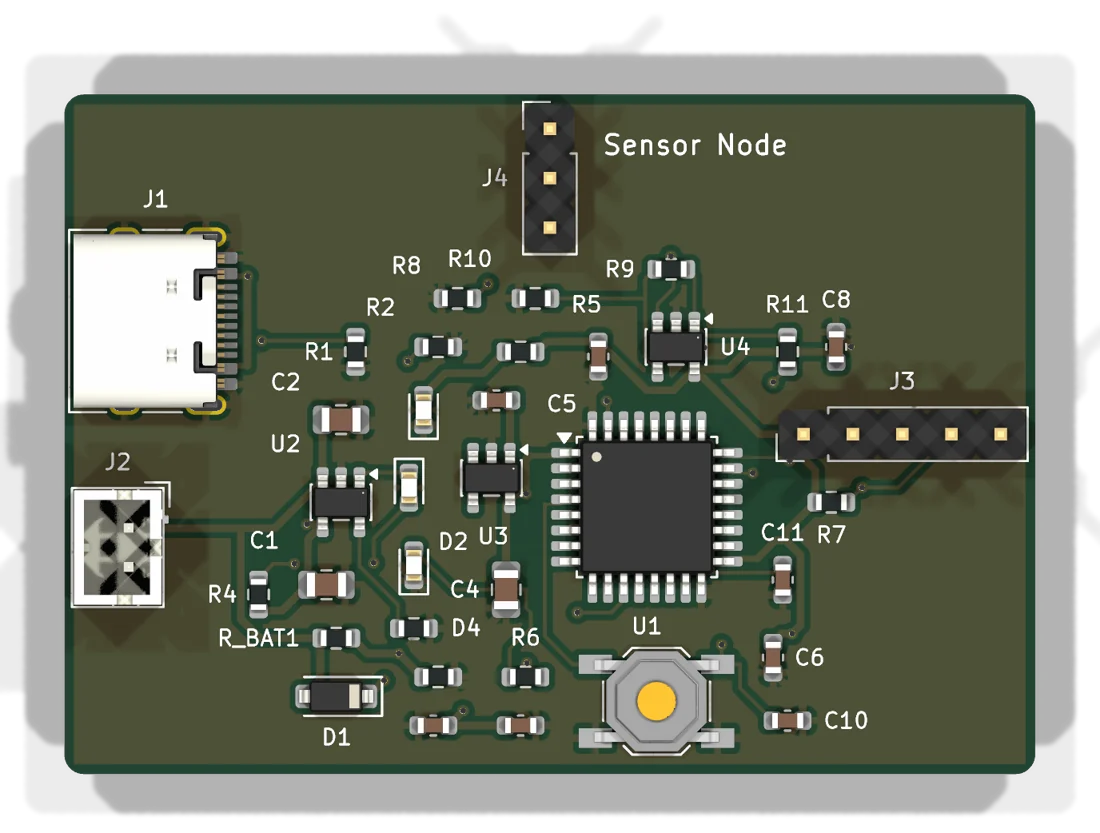
- Placement and routing with ground pours to IPC-2221 spacing, checked by a design rules check, with a 3D model
1.3Standards checkpassed2.1Library match: 37 of 37 partspassed2.2Ratings: voltage, current, powerpassed3.3Electrical rules check0 errors4.2Routing: 2 layers, 28 vias0 unrouted4.3Design rules check + 3D model0 errors5.1Manufacturing files11 filesAn engineer where judgement matters.
Automation covers the rules. Our engineers cover the parts a checker cannot: the design intent, unusual parts and anything connected to mains.
- Custom parts: symbol and footprint built from the datasheet when a part is not in the library, with the pin table confirmed by an engineer
- Equivalent parts proposed only when they keep the same function and ratings
- Mains designs get high-voltage clearances and a recorded engineer sign-off before release
- Design review of your own design files before they go to fabrication
A BOM that can actually be bought.
Purchasing part numbers are fixed when the BOM is frozen, so the board you approved is the board that gets built. We buy from authorized distributors and check every line before an order.
- Manufacturer part numbers matched to the footprint on the board
- Lifecycle and availability checked before purchase, with alternatives where needed
- Turnkey, hybrid or consigned: we buy everything, part of it, or kit what you send
- RoHS and REACH declarations collected for parts delivered into the EU
U1STM32L031K6T6 · LQFP-32ratedU2MCP73831T-2ACI/OT · SOT-23-5ratedU3AP2112K-3.3TRG1 · SOT-23-5ratedU4MCP6001T-I/OT · SOT-23-5ratedD1MBR0520LT1G · SOD-123ratedJ1USB-C receptacle · HRO TYPE-C-31-M-12footprint ✓J2JST PH 2-pin · B2B-PH-Kfootprint ✓Verified files go straight to the line.
The release package is made for manufacturing: Gerbers and drill files for fabrication, BOM and pick-and-place for SMT assembly. We manage the build from prototype batches to series production.
- Board fabrication from the released Gerber and drill files
- SMT and through-hole assembly from the BOM and pick-and-place files, in Excel and JLCPCB CSV
- Inspection by AOI, with X-ray for fine-pitch and hidden-joint packages
- Delivery into the EU handled from Tallinn, including customs
How a project runs.
Brief or files
Describe the board in the studio, or send a BOM, schematic or design project.
Design and checks
The design passes every stage: library, ratings, ERC, DRC and safety review.
Quote and sourcing
You get a quote on the frozen BOM. Parts are ordered once you approve it.
Build and deliver
Fabrication, assembly and inspection, then delivery into the EU.
Start small. Hand over more when you want.
Studio
Run the design studio yourself and download the verified design project and manufacturing files.
- All 15 gated steps
- Design project, Gerbers, BOM, CPL
- 3D model and wired schematic
Studio + engineer
The studio with one of our engineers reviewing the design, building custom parts and signing off.
- Everything in Studio
- Custom parts from datasheets
- Engineer review and safety sign-off
Turnkey
We design, source, fabricate, assemble and deliver. One quote, one contact, one set of files.
- Everything above
- Sourcing from authorized distributors
- Fabrication, assembly, EU delivery
Questions we get asked.
Do I own the design files?
How do you make sure the design is right?
What if a part is not in the library?
Can you handle mains-powered designs?
Which boards can the studio design?
Where do you deliver?
Tell us what you are building.
Send a description, a BOM or your design files. We reply with questions or a quote.